How to Potty Train Your Toddler: A Realistic Guide from a Twin Mom
Potty training is one of those milestones that feels both exciting and overwhelming, and when you’re doing it with twins, the stakes feel even higher. When I started researching, I found very little out there specifically for twin parents. Most of what I did find said to wait until both kids showed signs of readiness before starting, even if one was clearly ahead of the other.
I took a different approach. And it worked. Here’s what I’d share with any twin parent getting ready to tackle this.
Quick note: Everything here is based on my personal experience as a twin mom, not professional guidance. I do have a background in early childhood education, but potty training at typical developmental ages wasn’t part of my professional work. The American Academy of Pediatrics recommends starting when your child shows signs of readiness — generally between 18 months and 3 years — and following your child’s lead rather than a fixed timeline. Your pediatrician is always your best resource.
Should You Train Both Twins at the Same Time?
The most common advice I found was to wait until both twins are ready before starting either of them. I understand the logic, but I don’t fully agree with it.
My approach: if one child is showing readiness, go ahead and begin with both. If the other isn’t quite there yet, that’s okay, it won’t harm them to be exposed to the process. What matters is that you manage your expectations going in and treat each child as an individual.
That mindset is what made our experience a positive one, even though my twins progressed at different speeds.
Signs Your Child (or Twins) Are Ready to Start
Rather than going by age alone, watch for these readiness signals in each child individually:
- Communication — Can they express their needs, whether through words, signs, or gestures? Can they follow simple one-step directions? This one is big. Potty training is dramatically easier when you and your child can communicate with each other.
- Body awareness — Do they recognize the sensation of needing to go, even if they don’t have full control yet? My kids started going to the bathroom outside while playing naked in the yard, and I could see them beginning to connect the feeling with what was happening.
- Interest in the bathroom — Are they curious about the toilet? Do they want to flush? Enthusiasm is a green light.
One thing worth knowing: a common generalization is that girls do tend to show readiness a bit earlier and often catch on faster. That was true with my boy/girl twins. My daughter progressed quickly; my son took more time. Both got there, just on different timelines, and that’s completely normal.
The American Academy of Pediatrics notes that most children show readiness signals somewhere between 18 months and 3 years, though some aren’t ready until closer to 3 or 4. Don’t let a specific age drive the decision.
Before You Start: Make a Plan
Going into potty training without a plan, especially with twins, is going to feel chaotic and inconsistent for your kids. You don’t need a rigid script, but you do need a shared understanding of what this process is going to look like.
Here’s what to align on before day one:
With your co-parent or caregivers:
- What language will you use? What are you calling it when they urinate? When they have a bowel movement? What are you calling the toilet?
- What’s your incentive system, and how will you use it?
- How will you handle accidents, what do you say, what do you do?
- What are your expectations for the first few days, and beyond?
With your daycare or school (if applicable): You won’t always be able to do things the exact same way, but talking with your child’s caregivers helps everyone stay aligned. Try to agree on language at minimum, hi sweetie how are you they were good just like fighting with each other magnet tiles but otherwise good how was your how was your day using the same words at home and at school helps kids generalize the skill across settings, which is when it really sticks.
We had an au pair living with us at the time, and I made sure she felt prepared and confident too. The more consistent the experience is across adults, the easier it is for your kids.
Choosing Your Method: The Three-Day Launch vs. a Gradual Start
You’ve probably heard of potty training in three days, the method where you stay home, eliminate screens, and watch your child like a hawk for 72 hours straight. I’ll be honest: I love it as a starting point. I read the book and did take away a lot of great tips! But I’d push back on the idea that it’s a complete solution.
In my experience, and based on conversations with many other parents, no child is truly 100% potty trained in three days. It’s a launch, not a finish line. The full process, from that first successful trip to the bathroom to genuine independence, can one to two years. Setting that expectation upfront will save you a lot of frustration.
For my family, the strict three-day method also wasn’t realistic. My twins were two years old, we needed to leave the house daily, and I wasn’t going to commit to three days of house arrest with two toddlers.
So we adapted it. We committed to three full mornings (the wake window before their afternoon nap) of staying home, no TV, and my full attention on the kids. In the afternoons, we went out and lived normally.
How to Prepare for Potty Training
A little prep work in the days before you start makes a real difference, especially for getting kids excited rather than anxious.
- Read potty training books together. We read a few in the week before we started and the kids genuinely got excited. Some we liked:
- Daniel Tiger’s Potty Time!
- Potty Time with Bean
- P is for Potty!
- Dino Potty
- Watch a potty-themed episode or video. We watched the Miss Rachel episode where Bean goes potty. It was a hit and got both kids talking about it.
- Stock up on fun drinks. Full bladders give you more practice opportunities in those first days. We let the kids pick out juice boxes, which made it feel like a special occasion.
- Buy new underwear together. Letting kids choose their own underwear builds buy-in. They were proud to wear them.
- Agree on your incentive. We used M&Ms, one per successful trip to the potty. You can use anything: a sticker chart, a small toy, a song they love. What matters is that the connection is clear and consistent. When I do A, I get B.
The First Few Days: What to Actually Do
Keep them in underwear or nothing. For my son in particular, being naked worked better in those early days. For my daughter, underwear was never a barrier to success.
Stay close and watch for cues. When accidents happened, I’d scoop them up and move them to the bathroom as quickly as possible. That transition, from feeling the sensation to sitting on the potty, is how they learn.
Bring them to the bathroom regularly. You don’t need to follow a rigid schedule, but you do want to be proactive about taking them throughout the day. I didn’t go by a set timer or cadence, I just tried to bring them often enough that they were practicing regularly, without doing it so frequently that it started to feel frustrating or forced for them. Read your kids and adjust accordingly.
Use calm, consistent language around accidents. We said things like, “It’s okay, it’s just an accident. Let’s go try on the potty.” No shame, no big reaction. Just matter-of-fact and move on.
Celebrate every success. We were enthusiastic. They celebrated each other. The M&Ms came out. Keep the energy positive, it genuinely affects outcomes.
Don’t stress about going out. Contrary to what the strict three-day method says, I didn’t throw out all our diapers. When we were going somewhere that an accident would be stressful, I used a diaper. It didn’t set them back. Do what works for your family.
Within those first two to three mornings, both of my twins had their first successful trips to the potty. My daughter progressed quickly. My son had more accidents and took more time, but he was still trending upward, the experience was positive, and we kept with it. He got there.
Keeping It Positive: Why It Matters More Than You Think
Unintentionally making potty training a negative experience, whether through pressure, shame around accidents, or parental frustration, can create anxiety that drags the process out and causes real issues down the road.
We made a decision before we started: if this became too stressful or negative for us or for either of my kids, we’d stop and try again later. That took the pressure off everyone.
We had zero tears through the whole process. I think that’s because we kept the stakes low, kept celebrating the wins, and never made accidents into a big deal.
Whatever method you use, this is the piece I’d hold onto most tightly.
After the First Few Days: Making It Part of Daily Life
Once those initial intensive mornings were behind us, we shifted into incorporating potty training into our regular routine:
- At home: Underwear most of the time.
- Out of the house: Underwear when we felt comfortable, a pull-up when we didn’t. Use your judgment based on where you’re going and your own comfort level. My daughter quickly moved to only underwear out of the house, whereas it took a bit longer with my son.
- Before leaving the house: Getting kids to go on the potty before you head out is its own challenge. For my son, the solution was letting him pee outside before we left. Be flexible. Do what works.
My daughter started school that fall in underwear and never looked back. My son took longer and had more accidents along the way, but he got there too, without regression, and without any negative associations around the process.
On nighttime and nap time: Both of my kids still use a pull-up for sleep. This is completely normal. Staying dry overnight is a different developmental skill that comes later, once kids can physically hold their bladder for longer and wake themselves up when they need to go. Don’t rush it.
Recommended Products
Here’s what we actually used and found helpful:
- Potty seat insert — Sits on top of the regular toilet seat. Since my kids weren’t afraid of the big toilet, I wanted them to learn on it from the start, that way, using public restrooms out and about was never an issue.
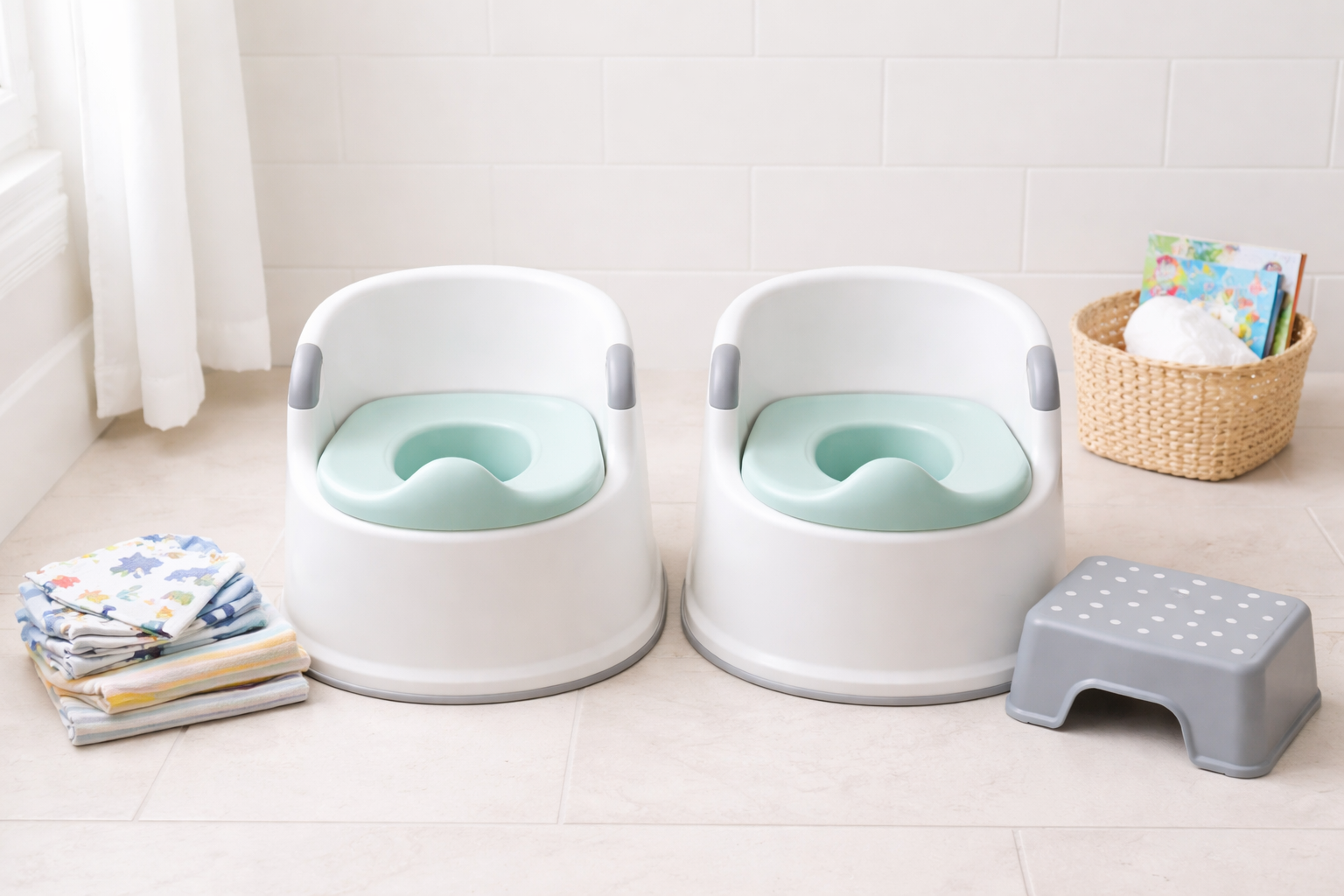
- Step stools (x2) — One for getting up to the toilet, one at the sink for independent hand washing.
- Fold-down toilet seat — We have one in our playroom with a built-in smaller seat that folds down. Easy for kids to use independently and easy to keep clean.
- Potty training books — Read these in the days before you start to build excitement.
- Travel/portable potty — We had one but didn’t end up using it much. If going outside isn’t your thing or you want a backup option for outings, there are many options out there!
The Bottom Line
Potty training twins is its own adventure. You’re managing two kids at different stages, different paces, and different personalities, while trying to keep your daily life intact. Give yourself grace.
Go in with a plan. Make it positive. And know that however you start, whether it’s a hard launch or a slow build, this is a process that unfolds over months, not days. That’s completely normal, and it doesn’t mean you’re doing anything wrong.
You’ve got this.